Safekipedia

Milk

Explorer · ages 7 and underAdapted from Wikipedia
A glass of cold milk, a drink many people enjoy with breakfast or snacks.

What Is Milk?

Milk is usually a white food. Sometimes it can be yellow, cream, pink, or brown. It is made by the mammary glands of mammals that have babies.

Milk is the first food for baby mammals. It has calcium and protein, which help bodies grow strong.

Where Milk Comes From

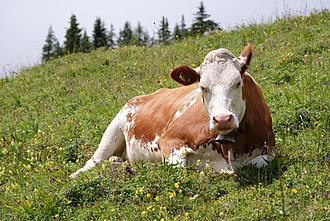
Most milk comes from cattle on a dairy farm. People drink milk and use it to make dairy products. Foods like cheese, butter, yogurt, and ice cream are all made from milk.

In 2011, dairy farms made about 730 million tonnes of milk. India makes more milk than any other country in the world. Many families depend on dairy farming every day.

A Long Time Ago

People began drinking the milk of other animals after they tamed them. This happened when farming began, a very long time ago.

In 1863, Louis Pasteur found a way to heat drinks so they would not go sour. This way of heating is called pasteurization. It is named after him.

A glass of cow milk

Quiz time!

3 questions about Milk

Question 1 of 3

What color is milk usually?

Pictures

A rotary milking parlor, where cows are milked on a slowly turning platform.
A mother feeding her baby. Breastfeeding provides babies with food and comfort in their first months of life.
A young goat kid drinks milk from its mother in Victoria, Australia.
A black-and-white Holstein-Friesian dairy cow, a breed known for producing large amounts of milk.
A bowl of milk prepared for a shaman ritual in Buryatia, Russia, a region where traditional customs and food are an important part of local culture.
A six-wheeled milk wagon, once used to carry milk by rail, on display at the Didcot Railway Centre in England.
A milk vehicle transporting milk cans in Salem, a city in Tamil Nadu, India.
A modern barn at a dairy farm in Sogn og Fjordane, Norway, where cows are raised for milk.
A mother goat with her two-week-old kids, photographed in Swifts Creek, Victoria, Australia.
Water buffaloes grazing near the Watawe Ganga river in the southern part of Sri Lanka.
A graph showing how the price of a gallon of whole milk has changed over time.
A milking machine attached to a cow at an agricultural fair, showing how farmers collect milk from cows.
The flag of the United States of America, shown here as a small icon.
Two delivery boys from the Bolle dairy cool off with milk during a hot day in Berlin in 1932.
Note that the green portion of the flag was designed to represent the majority Catholic residents of the island, the orange side the minority Protestant and the white middle part peace and harmony between them.
Flag of Finland
Flag of the United Kingdom, Union Jack or Union Flag in a 1:2 ratio (typical on British warships and also the rank flag of an admiral of the fleet).
Flag of Australia, when congruence with this colour chart is required (i.e. when a "less bright" version is needed). See Flag of Australia.svg for main file information.
Flag of Canada introduced in 1965, using Pantone colours. This design replaced the Canadian Red Ensign design.
The Flag of Europe is the flag and emblem of the European Union (EU) and Council of Europe (CoE). It consists of a circle of 12 golden (yellow) stars on a blue background. It was created in 1955 by the CoE and adopted by the EU, then the European Communities, in the 1980s. The CoE and EU are distinct in membership and nature. The CoE is an international organisation with 46 members, dealing with human rights and rule of law, while the EU is a quasi-federal union of 27 states, focused on economic integration and political cooperation. Today, the flag is mostly associated with the latter. It was the intention of the CoE that the flag should come to represent Europe as a whole, and since its adoption the membership of the CoE covers nearly the entire Europe by the number of states involved, although only a little over half of the European continent by territory. This is why the EU adopted the same flag. The flag has been used to represent Europe in sporting events and as a pro-democracy banner outside the European Union.
Flag of Greece (since 1978) and Naval Ensign of Greece (since 1828)
Flag of the Netherlands
Flag of the People's Republic of China

Keep exploring

This article is a child-friendly adaptation of the Wikipedia article on Milk, available under CC BY-SA 4.0.

Images from Wikimedia Commons. Tap any image to view credits and license.