Accelerating expansion of the universe
Observations show that the expansion of the universe is accelerating. This means that the velocity at which a distant galaxy moves away from us keeps increasing over time. Two separate research teams, the Supernova Cosmology Project and the High-Z Supernova Search Team, discovered this accelerated expansion in 1998. They used distant type Ia supernovae to measure it.
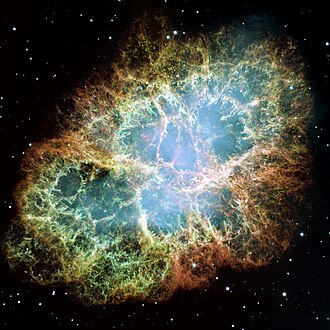
Type Ia supernovae are almost equally bright, so they work like a standard candle. Because faraway objects look dimmer, scientists could use how bright these supernovae appeared to find how far away they were. That distance could then be compared with their redshift, which shows how much the universe has expanded since the supernova happened. The Hubble law showed that the farther away an object is, the faster it moves away. The surprising result was that objects in the universe are moving apart at an ever-faster rate. At the time, scientists expected that this movement would slow down because of the pull of gravity from all the matter in the universe.
Three members of these two groups have since been given Nobel Prizes for their discovery. More evidence supporting it has come from baryon acoustic oscillations and from studies of the clustering of galaxies.
The accelerated expansion is thought to have started when the universe entered its dark-energy-dominated era, roughly 5 billion years ago. Within the framework of general relativity, this accelerated expansion can be explained by a positive value of the cosmological constant Λ. This is the same as having a positive vacuum energy, which has been called "dark energy".
There are other possible explanations, but the standard model of cosmology uses the idea of dark energy. This model also includes cold dark matter (CDM) and is known as the Lambda-CDM model.
Background
Further information: Cosmological constant, Lambda-CDM model, Hubble's law, Friedmann–Lemaître–Robertson–Walker metric, and Friedmann equations
Main article: Baryon acoustic oscillations
See also: Age of the universe
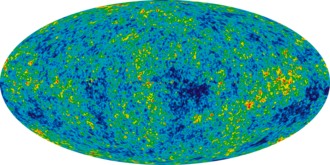
Since the detection of the cosmic microwave background (CMB) in 1965, the Big Bang model has become the most accepted explanation of how our universe evolved. Scientists think four things make up the energy of the universe: curvature, matter, radiation, and dark energy. Physicists use the values of these parts to work out how the universe is expanding. At one time, physicists were so sure the expansion was slowing down that they introduced a deceleration parameter, but recent observations suggest this parameter is negative. The very early universe is also thought to have gone through a very fast expansion during cosmic inflation.
In 1998, the first evidence that the expansion is speeding up came from Type Ia supernovae, which are exploding white dwarf stars. Because these stars have similar masses, their brightness can be used to measure how far away they are. Scientists found the supernovae by repeatedly photographing parts of the sky, and they used the light from the explosions to measure their redshift. Researchers such as Adam Riess found that the most distant supernovae were further away than expected for a universe that was slowing down. Some researchers have questioned this main view, and later studies of galaxy clusters and gravitational waves, detected by LIGO and VIRGO, have also been used to study how fast the universe is expanding.
Explanatory models
Main article: Dark energy
See also: Dark energy § Theories of dark energy, and Dark energy § Alternatives to dark energy
Dark energy is thought to push things apart. Its most important property is that it has negative pressure, which acts in a way that repels, and it is spread fairly evenly through space. Different theories suggest different values for its properties. Other explanations have also been proposed. Quintessence is a suggested form of dark energy whose density decreases over time. A negative mass model finds a negative cosmological constant, and Occam's razor suggests this is the simpler idea. Dark fluid tries to join dark matter and dark energy into one idea. Some authors have argued that the speeding up could be due to a repulsive effect of antimatter on gravity, or to gravity working differently, as in massive gravity. The measurement of the speed of gravity with the gravitational wave event GW170817 ruled out many of these changed-gravity ideas.
Other ideas include shockwave cosmology, which was proposed in 2003, and a model that suggests the speeding up is caused by how the universe is shaped and measured. Shockwave cosmology would still need more work to explain things like the Lyman-alpha forest before it could be preferred over the big bang theory. Another idea is that dark energy may be an illusion caused by measurement mistakes, such as living in an emptier-than-average part of space. Using a equivalence principle extended to the whole universe, space might seem to expand faster in the empty areas around us, which could create the impression of a Hubble bubble. Scientists still do not know which idea is correct.
Consequences for the universe
See also: Future of an expanding universe
As the universe grows, the density of radiation and ordinary dark matter drops faster than the density of dark energy (see equation of state). Eventually, dark energy dominates. When the size of the universe doubles, the density of matter is reduced by a factor of 8, but the density of dark energy is nearly unchanged. If dark energy is the cosmological constant, it stays exactly the same.
In models where dark energy is the cosmological constant, the universe will expand faster and faster over time in the far future, coming closer to a de Sitter universe. This will eventually lead to all evidence of the Big Bang disappearing, as the cosmic microwave background fades to lower intensities and longer wavelengths. Eventually, it will be absorbed by the interstellar medium and hidden from observers within the galaxy. This will happen when the universe is less than 50 times its current age, and cosmology will end as the distant universe turns dark. In such a universe, matter will break apart into isolated stable particles such as electrons and neutrinos, and all complex structures will fall apart. This is called "heat death of the universe" (or the Big Freeze). Other possible ultimate fates of the universe include the Big Rip mentioned above, a Big Bounce, or a Big Crunch.

Quiz time!
5 questions about Accelerating expansion of the universe
What does 'accelerating expansion of the universe' mean?
Pictures
Keep exploring


This article is a child-friendly adaptation of the Wikipedia article on Accelerating expansion of the universe, available under CC BY-SA 4.0.
Images from Wikimedia Commons. Tap any image to view credits and license.