 Safekipedia
Province
Adapted from Wikipedia · Discoverer experience
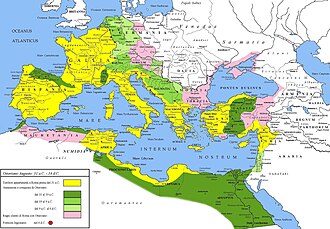
A province is a special part of a larger country or state that helps organize and manage its areas. The word comes from ancient times, from the ancient Roman provincia, which was a big region ruled by Rome outside of Italy. Many countries today use the term "province" to describe these important sections.
In some places, provinces were created by faraway rulers, but in others, they grew from local groups with their own traditions and cultures. Some provinces, like those in Canada, have their own powers and make their own decisions. In places such as China or France, provinces are set up by the main government and don’t have as much freedom to act on their own.
Sometimes, when people talk about “the provinces,” they mean areas away from the big capital city. This shows how provinces can be both real places and ways to describe parts of a country that are not the main center of action.
Etymology
The word province comes from old languages. It started in English around the year 1330, from the Old French word province. This word, in turn, came from the Latin word provincia. In ancient times, provincia meant a place or job that a Roman leader was in charge of for the government.
Some people think the word comes from Latin words meaning "on behalf of" and "to take control of." This would mean a province is a place a Roman leader controlled for the government. The word province actually means a job or area that a Roman leader was responsible for.
History and culture
In France, the phrase en province means "outside the Paris area". Similar expressions are used in Peru (en provincias, "outside the city of Lima"), Mexico (la provincia, "lands outside Mexico City"), Romania (în provincie, "outside the Bucharest area"), Poland (prowincjonalny, "provincial"), Bulgaria, the Netherlands (uit de provincie, "from outside Amsterdam"), and the Philippines (tagá-probinsiya, "from outside Metro Manila").
Before the French Revolution, France had many different regions, some called "provinces". Today, people often use the word région instead.
In Italy, in provincia usually means "outside the biggest cities" like Rome, Milan, and Naples.
The British colonies in North America were often called provinces. Most of the Thirteen Colonies that became the United States changed their names to "states" after independence. The colonies that stayed with Britain, now Canada, kept the name "province".
Legal aspects
In many countries that have a system where power is shared between a central government and smaller parts called provinces or states, these smaller parts often have their own important powers. These powers are decided in a document called a constitution. For example, in Canada, provinces have control over things like property, civil rights, education, social welfare, and medical services. Because these areas have become more important over time, provincial governments in Canada have gained more influence than originally planned.
In Canada, provinces can also make their own laws and collect certain taxes. Even though the national government can collect taxes for both levels, provinces can ask for extra money from these taxes. There can be disagreements between the national government and provinces about who has control over certain issues, leading to changes in laws to balance these powers.
Current provinces
See also: Administrative divisions
Not all first-level political entities are termed "provinces." In Arab countries, the first administrative level of government—called a muhafazah—is usually translated as a "governorate." In Poland, the equivalent of "province" is "województwo," sometimes rendered in English as "voivodeship."
Historically, New Zealand was divided into provinces, each with its own Superintendent and Provincial Council, and with considerable responsibilities conferred on them. However, the colony (as it then was) never developed into a federation; instead, the provinces were abolished in 1876. The old provincial boundaries continue to be used to determine the application of certain public holidays. Over the years, when the central Government has created special-purpose agencies at a sub-national level, these have often tended to follow or approximate the old provincial boundaries. Current examples include the 16 Regions into which New Zealand is divided, and also the 21 District Health Boards. Sometimes the term the provinces is used to refer collectively to rural and regional parts of New Zealand, that is, those parts of the country lying outside some or all of the "main centres"—Auckland, Wellington, Christchester, Hamilton and Dunedin.
In many countries, a province is a relatively small non-constituent level of sub-national government, such as a county in the United Kingdom. In China, a province is a sub-national region within a unitary state; this means that a province can be created or abolished by the national people's congress.
In some nations, a province (or its equivalent) is a first-level administrative unit of sub-national government—as in the Netherlands—and a large constituent autonomous area, as in Argentina, Canada, South Africa, and the Democratic Republic of the Congo. It can also be a constituent element of a federation, confederation, or republic. For example, in the United States, no state may secede from the federal union without the permission of the federal government.
In other nations—such as Belgium, Chile, Italy, Peru, the Philippines, and Spain—a province is a second-level administrative sub-division of a region (which is the first-order administrative sub-division of the nation). Italian provinces are mainly named after their principal town and comprise several administrative sub-divisions called comuni (communes). In Chile, they are referred to as comunas. Chile has 15 regions, subdivided into 53 provinces, of which each is run by a governor appointed by the president. Italy has 20 regions, subdivided into 14 metropolitan cities and 96 provinces. Peru has 25 regions, subdivided into 194 provinces. Spain has 17 autonomous communities and 2 autonomous cities, subdivided into 50 provinces.
The island of Ireland is divided into four historic provinces (see Provinces of Ireland), each of which is sub-divided into counties. These provinces are Connacht (in the west), Leinster (in the east), Munster (in the south) and, Ulster (in the north). Nowadays these provinces have little or no administrative function, though they do have sporting significance. Northern Ireland is frequently called "the Province" or "Ulster" in British media, although it includes just six of the nine counties of the original province.
From the 19th century, the Portuguese colonies were considered overseas provinces of Portugal.
Similarly, some overseas parts of the British Empire bore the colonial title of "province" (in a more Roman sense), such as the Province of Canada and the Province of South Australia (the latter, to distinguish it from the penal "colonies" elsewhere in Australia). Likewise, prior to the American Revolution, most of the original Thirteen Colonies in British America were provinces as well, such as the Province of Georgia and the Province of New Hampshire.[citation needed]
Canada
The constituent entities of Canada are known as provinces. Prior to confederation, the term province was used in reference to several British colonies situated in what is now Canada; such as the colonial Province of Quebec. In 1791, Quebec split into two separate provinces, Lower Canada, and Upper Canada. The two colonies were later merged in 1841 to form the Province of Canada. From its separation from Nova Scotia in the 18th century, New Brunswick was known as His/Her Majesty's Province of New Brunswick. After Canadian Confederation in 1867, the term provinces continued to be used, in reference to the sub-national governments of Canada.
Because Canada is the second-largest country in the world by area, but has only 10 provinces, most Canadian provinces are very large—six of its ten provinces are larger than any country in Europe except Russia, and its largest province—Quebec, 1,542,056 km2 (595,391 sq mi)—is almost two and a half times as large as France—640,679 km2 (247,368 sq mi). Five provinces—Ontario, Quebec, New Brunswick, Nova Scotia and Prince Edward Island—have "counties" as administrative sub-divisions. The actual local government form can vary widely. In New Brunswick, Prince Edward Island, and in 9 of the 18 counties of Nova Scotia, county government has been abolished and has been superseded by another form of local government. New Brunswick and Prince Edward Island also have parishes within counties. Since the Canadian Constitution assigns local government to provincial jurisdiction, the various provinces can create, dissolve, and reorganize local governments freely and they have been described as "creatures of the province".
The Western provinces have more varied types of administrative sub-divisions than the Eastern provinces. The province of British Columbia has "regional districts" which function as county-equivalents. Manitoba and Saskatchewan are divided into rural municipalities.
Alberta is also divided into counties, albeit they are officially classified as "municipal districts" by the province, though in regular everyday parlance these entities are referred to as a "county". Alberta has some unique local governance schemes formed in response to local conditions. For instance, Sherwood Park is an unincorporated "urban service area" of 72,017 within Strathcona County, which has most of the oil refining capacity in Western Canada; Fort McMurray was once a city but dissolved itself and became an "urban service area" of 70,964 people within the Regional Municipality (R.M.) of Wood Buffalo, which has several multibillion-dollar oil sands plants; and Lloydminster, a city of 31,483 which sits directly astride the border between Alberta and Saskatchewan. Unlike most such cases, Lloydminster is not a pair of twin cities on opposite sides of a border, but is actually incorporated by both provinces as a single city with a single municipal administration. The residents objected to the federal government splitting the city in two when it created the two provinces, so the two provinces reunified it by declaring it to be a single city in two provinces, thereby bypassing the limitations of a twin-city arrangement.
Pakistan
Pakistan is administratively divided into four provinces:
It also has two autonomous territories:
Russia
The term "province" is sometimes used to refer to the historic governorates (guberniyas) of Russia. This terms also refers to the provinces (провинции), which were introduced as the subdivisions of the governorates in 1719 and existed until 1775. In modern parlance, the term is commonly used to refer to the oblasts and krais of Russia.
Polities translated
Historic provinces
The idea of a province comes from ancient Rome, where big parts of their empire were called provinces. Many countries later used this idea to organize their own lands.
Over time, many places like empires and kingdoms had their own ways of setting up provinces. For example, the Roman Empire, the Caliphate, and even places like Pharaonic Egypt all had special names for their areas. Later, countries such as Spain, Britain, and France also set up provinces in their colonies and lands around the world.
Related articles



This article is a child-friendly adaptation of the Wikipedia article on Province, available under CC BY-SA 4.0.
Images from Wikimedia Commons. Tap any image to view credits and license.