Upper Tanana language
Upper Tanana is an endangered Athabaskan language. It is also known as Tabesna, Nabesna, or Nee'aanèegn'. Endangered means that few people still use the language, so it is at risk of disappearing.
The language is spoken in eastern Interior Alaska, in the United States. It is mainly spoken in the villages of Northway, Tetlin, and Tok, and in nearby areas of the Canadian territory of Yukon.
In 2000, there were fewer than 100 speakers of Upper Tanana. Children were no longer learning the language. The name Nabesna can also refer to a community, which you can read about at Nabesna, Alaska.
Overview
Upper Tanana sounds very similar to its neighbor, Tanacross, and speakers of the two languages can mostly understand each other. The languages still differ in some sounds. For example, Upper Tanana has low tone where Tanacross has high tone, as a result of Proto-Athabaskan constriction. Upper Tanana also has an extra vowel sound and has developed diphthongs by losing final consonants.
Traditionally, five main dialects have been recognized. Today, the main Upper Tanana speaking communities are in the Alaskan communities of Northway and Tetlin and in the Canadian community of Beaver Creek.
Name
There are two Tanana languages. The first is Lower Tanana, also called Minto. The second is Upper Tanana, also called Nabesna. The original name for the Upper Tanana language was Nee'aaneegn'.
Language today
At the beginning of the 21st century, roughly 100 people still speak the language. The Upper Tanana speakers are mostly over the age of 60. The language is no longer taught to children of this generation, so the language is likely to disappear in the near future.
In the 1960s, Paul G. Milanowski and Alfred John worked together to create a writing system. They used it to make several booklets and school dictionaries to help with bilingual programs.
Geography
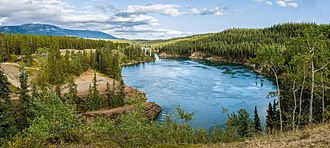
Upper Tanana is spoken in the eastern part of Alaska, in the same area where speakers of the Tanacross language live. The area stretches from the Wrangell Mountain range to Joseph Creek, and lies west of the Tanana rivers. A string of smaller rivers and creeks divides the area. Upper Tanana is mainly spoken in Tetlin and Northway.
Upper Tanana has five dialects. The Tetlin band speaks the first, and it has up to 20 known speakers. The other four are spoken by smaller bands further upriver. The Nabesna dialect has two known speakers, and the Northway dialect has 20. The Scottie Creek dialect no longer has any known speakers. The Beaver Creek dialect has one known speaker, but there is a good chance that a few more people speak it. In 2014, the state of Alaska recognized Upper Tanana, along with 19 other Alaska Native languages, as an official language of the state.
Phonology
The Upper Tanana writing system uses 13 vowels, 34 consonants, and five tones.
Consonants
Vowels
Tone
The Upper Tanana language has five separate tones.
| Tone | Letter | Example | Meaning |
|---|---|---|---|
| low tone | e | nen | you |
| high tone | é | nén' | land |
| falling tone | ê | jêg | berries |
| rising tone | ě | ts'ěd' | blanket |
| extra-high tone | ő | ch'ekől | n/a |
Vocabulary
Here are some examples of English words translated into Upper Tanana.
| English | Upper Tanana |
|---|---|
| bear | sh'oo |
| berry | Jign |
| bunny | Gah |
| dog | łii |
| salmon | łuuk |

Quiz time!
5 questions about Upper Tanana language
Why is Upper Tanana called an endangered language?
Keep exploring


This article is a child-friendly adaptation of the Wikipedia article on Upper Tanana language, available under CC BY-SA 4.0.
Images from Wikimedia Commons. Tap any image to view credits and license.