Safekipedia

Greco-Bactrian Kingdom

Explorer · ages 7 and underAdapted from Wikipedia
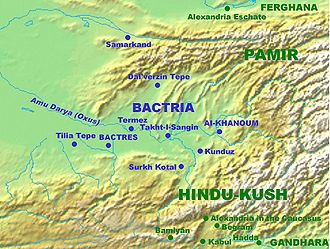
A map showing the extent of the Greco-Bactrian Kingdom at its largest, around 180 BC.

The Greco-Bactrian Kingdom was a kingdom with Greek rulers. It was in Central Asia and Afghanistan a long time ago.

Where It Was

The kingdom was also called the Kingdom of Bactria. At its biggest, it covered land that is now part of Afghanistan, Tajikistan, Uzbekistan, and Turkmenistan. A man named Diodotus I Soter started the kingdom around 256 BC.

Who Lived There

Greek people had been living in Bactria for a long time. Alexander the Great brought many more Greeks and Macedonians to the area. He built many cities, and most of them were named Alexandria.

Cities and Culture

The kingdom had many busy and rich cities. One of the most famous is Ai-Khanoum. It had a Greek theater, a gymnasium, and houses with courtyards. These show us how people lived there long ago.

The Greek style of art and writing spread far. Later, the Kushan Empire used the Greek alphabet to write their language. Greek art also mixed with Indian art to make a new style called Greco-Buddhist art.

Why People Remember It

The kingdom is important because it shows how Greek ideas traveled far to the east. A Chinese visitor named Zhang Qian wrote about Bactria, so people still learn about it today.

Quiz time!

3 questions about Greco-Bactrian Kingdom

Question 1 of 3

What kind of rulers did the kingdom have?

Pictures

A large gold coin from ancient Bactria, issued by the king Eucratides I, shown from both sides. It is the largest known gold coin from antiquity.
A gold coin from around 245 BC, issued by King Diodotus I of Bactria. The Greek writing on it reads "of King Diodotus."
A silver coin called a tetradrachm, minted about 2,200 years ago for Euthydemus I, a king who ruled a Greek kingdom in Bactria in Central Asia.
A silver coin from the Greco-Bactrian Kingdom, minted around 170–145 BC under King Eukratides I. One side shows the king's portrait wearing a helmet, and the other shows the twin horsemen Dioskouri galloping.
A bilingual coin of King Eucratides I, who ruled the Greco-Bactrian Kingdom around 2,200 years ago. Coins like this one show how ancient rulers presented themselves to the people they governed.
A map showing the migrations of the Yuezhi, an ancient people who moved across Central Asia.
A pair of ancient gold pendants decorated with turquoise, garnet, and other gemstones, found in a tomb at Tillya Tepe in Afghanistan and dating from the 1st century.
A silver coin issued by Plato Epiphanes, a Greco-Bactrian king who ruled in ancient Central Asia over 2,000 years ago.
The front side of a silver tetradrachm coin minted under the Greek king Eukratides I, who ruled in Bactria in Central Asia around 170–145 BCE.
A Corinthian capital from the ancient city of Aï Khanoum in Afghanistan, carved from limestone around 2,200 years ago and displayed at the National Museum of Afghanistan in Kabul.
A coin showing Demetrius I, an ancient king of Bactria who ruled a Greek kingdom in Central Asia around 2,200 years ago.
An illustration of an ancient coin of King Heliocles I, from an 1889 book about the principal coins of the ancient world.
Reconstruction of Kampyr Tepe (Alexandria Oxiana)
Stone block with the inscriptions of Kineas in Greek. Ai Khanoum.
Bronze Heracles statuette. Ai Khanoum. 2nd century BC.
Sculpture of an old man, possibly a philosopher. Ai Khanoum, 2nd century BC.

Keep exploring

This article is a child-friendly adaptation of the Wikipedia article on Greco-Bactrian Kingdom, available under CC BY-SA 4.0.

Images from Wikimedia Commons. Tap any image to view credits and license.