Safekipedia

Internet

Explorer · ages 7 and underAdapted from Wikipedia
The Blue Marble, a famous photo of Earth taken by the Apollo 17 astronauts in 1972 on their way to the Moon.

What is the Internet?

The Internet is a global system of connected computer networks. It is a network of networks. Some networks are small, and some reach all around the world.

The networks are joined together with cables, wireless signals, and optical networking technology. Devices can talk to each other using the Internet protocol suite (TCP/IP).

What can you do on the Internet?

The Internet carries many fun and useful things. You can send electronic mail, watch videos with streaming media, and share files with file sharing.

The World Wide Web is one of the most famous parts of the Internet. People use a web browser to look at web pages. People also use the Internet for online shopping and instant messaging.

How did it begin?

The Internet grew out of earlier research. The ARPANET started in 1969 with two connected sites. The Defense Advanced Research Projects Agency helped pay for this early work.

In 1990, Tim Berners-Lee built the tools needed for a working Web. This was the start of the Internet we know today.

Who looks after it?

No single group is in charge of the Internet. The Internet Engineering Task Force (IETF) is a non-profit group that looks after how the Internet works. The Internet Corporation for Assigned Names and Numbers (ICANN) helps keep the basic rules for names and IP addresses in order.

Quiz time!

3 questions about Internet

Question 1 of 3

What is the Internet?

Pictures

A colorful map showing how computers around the world are connected to the Internet, with each line linking two network points and its color showing the network group it belongs to.
A sketch of the ARPANET in December 1969, showing some of the first computer nodes connected in the network, including those at UCLA and the Stanford Research Institute.
A map of the NSFNET T3 backbone from fall 1992, showing how major computer networks were linked together across the United States to carry internet traffic.
A graph showing the share of the population that uses the Internet.
A world map showing how many people in each country use the internet, with darker colors showing higher shares of internet users.
A banner in Bangkok, Thailand, in 2014 telling people not to like or share certain online opinions on social media. This was after a military takeover of the government, and the sign shows how governments can limit what people say online.
The NeXT computer that served as the first Web server at CERN, shown as it was displayed in a science museum in 2005. Tim Berners-Lee used this machine to help invent the World Wide Web.
The headquarters of ICANN, the organization that helps coordinate internet addresses, located in Playa Vista, Los Angeles, California.
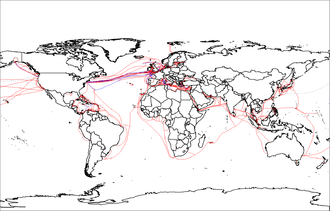
A 2007 world map showing the undersea telecommunication cables that carry internet and phone traffic between continents.
Internet users per 100 population members and GDP per capita for selected countries
As user data is processed through the protocol stack, each abstraction layer adds encapsulation information at the sending host. Data is transmitted over the wire at the link level between hosts and routers. Encapsulation is removed by the receiving host. Intermediate relays update link encapsulation at each hop, and inspect the IP layer for routing purposes.
Conceptual data flow in a simple network topology of two hosts (A and B) connected by a link between their respective routers. The application on each host executes read and write operations as if the processes were directly connected to each other by some kind of data pipe. After the establishment of this pipe, most details of the communication are hidden from each process, as the underlying principles of communication are implemented in the lower protocol layers.
Internet censorship and surveillance by country (2018)[e]  Pervasive  Substantial  Selective  Little or none  Unclassified / No data

Keep exploring

This article is a child-friendly adaptation of the Wikipedia article on Internet, available under CC BY-SA 4.0.

Images from Wikimedia Commons. Tap any image to view credits and license.