Safekipedia

Pyramid

Explorer · ages 7 and underAdapted from Wikipedia
An aerial view of the Giza pyramids and the Giza Necropolis in Egypt, ancient monuments built thousands of years ago as tombs for pharaohs.

What is a pyramid?

A pyramid is a building with triangle-shaped sides that meet at the top. The word comes from Ancient Greek. Some pyramids have smooth sides, and some have steps.

Most of a pyramid's weight sits low, near the ground. The shape gets narrower as it goes up, and this helped early people build very large structures.

Very old pyramids

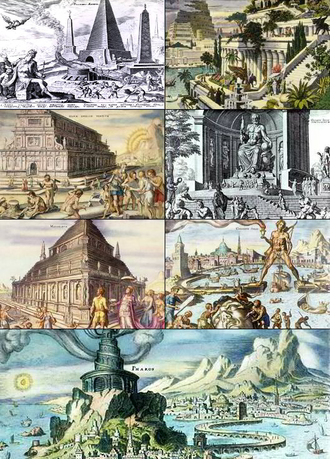
People in many parts of the world began building pyramids long ago. For thousands of years, the biggest structures on Earth were pyramids. The first was the Red Pyramid, and then came the Great Pyramid of Khufu. Both are in Egypt. The Great Pyramid of Khufu is the only one of the Seven Wonders of the Ancient World that still exists.

The Mesopotamians built some of the earliest pyramid-shaped buildings, called ziggurats. They were made of mud bricks. In Egypt, the first pyramid was built by the Pharaoh Djoser and his builder Imhotep.

Pyramids around the world

Pyramids can be found in many countries. In Sudan, there are many Nubian pyramids. In Indonesia, the Borobudur monument is a step pyramid. In China, there is a large mound that was built for the first emperor.

The largest pyramid by volume is the Great Pyramid of Cholula in the Mexican state of Puebla. The Pyramid of the Sun at Teotihuacan is also in Mexico.

Modern pyramids

Pyramids are still built today. The Louvre Pyramid in Paris, France, is made of glass. It is an entrance to a museum. American architect I. M. Pei designed it.

The Shard in London is a very tall building shaped like a pyramid. The Luxor Hotel in Las Vegas is also shaped like a pyramid. The Transamerica Pyramid in San Francisco is a famous symbol of its city.

Quiz time!

3 questions about Pyramid

Question 1 of 3

What shape are the sides of a pyramid?

Pictures

El Castillo, the step pyramid of Kukulcán at Chichén Itzá in Mexico, built by the ancient Maya.
The Prang, a tall stepped temple pyramid at Koh Ker in Cambodia, built as the state temple of King Jayavarman IV over 1,000 years ago.
The White Temple, an ancient ziggurat in the ancient city of Uruk in Mesopotamia (modern-day Iraq).
The White Temple at Uruk, a large mud-brick temple built in ancient Mesopotamia around 3500 to 3000 BCE.
The ancient pyramids of Meroe in the Northern Cemetery, in Sudan. Meroe was the capital of the Kingdom of Kush, and its pyramids were built as royal tombs.
A pyramid-shaped building in Elliniko, near Athens, Greece.
The Pyramids of Güímar, stone-terraced structures in the Canary Islands, Spain.
The Pyramid of Cestius, an ancient tomb in Rome, Italy, built around 12 BC for a Roman magistrate named Gaius Cestius.
The Pyramid of the Moon at Teotihuacan in Mexico, an ancient city known for its huge pyramids and temples.
A diagram showing the parts of a Mississippian platform mound, such as its layers of construction, temples, ramps with log stairs, and terraces built by the Mississippian and Plaquemine peoples of North America.
Monks Mound, the largest earthen mound at the Cahokia Mounds site in Illinois, built by the Mississippian people more than 1,000 years ago.
Chogha Zanbil, an ancient ziggurat in southwestern Iran built about 3,000 years ago, as it looked in 2005.
The ancient pyramids of Meroe, built by the Kushite kingdom in what is now Sudan.
Pyramid of Khafre, Egypt, built c. 2600 BC
Comparison of approximate profiles of several notable pyramidal or near-pyramidal buildings. Dotted lines indicate original heights, where data is available. In its SVG file, hover over a pyramid to highlight and click for its article.
Louvre Pyramid (Paris, France)
The Shard (London, United Kingdom)
Transamerica Pyramid in San Francisco, California

Keep exploring

This article is a child-friendly adaptation of the Wikipedia article on Pyramid, available under CC BY-SA 4.0.

Images from Wikimedia Commons. Tap any image to view credits and license.