Helicopter
For other uses, see Helicopter (disambiguation).
A helicopter is a type of rotorcraft in which lift and thrust are supplied by rotors that spin horizontally. This allows the helicopter to take off and land vertically, to hover, and to fly forward, backward, and sideways. These abilities let helicopters be used in crowded or isolated areas where fixed-wing aircraft and many types of short take-off and landing (STOL) or short take-off and vertical landing (STOVL) aircraft cannot work without a runway.
The Focke-Wulf Fw 61 was the first successful, practical, and fully controllable helicopter, in 1936. In 1942, the Sikorsky R-4 became the first helicopter to reach full-scale production. Starting in 1939 and continuing through 1943, Igor Sikorsky worked on the VS-300. Over four versions, it became the basis for modern helicopters with a single main rotor and a single tail rotor.
Most earlier designs used more than one main rotor. However, the setup of a single main rotor with a vertical anti-torque tail rotor (called a unicopter, not to be confused with the single-blade monocopter) has become the most common helicopter design. Twin-rotor helicopters (bicopters), in tandem or transverse rotors setups, are sometimes used because they can carry more weight than single-rotor designs. Coaxial-rotor, tiltrotor, and compound helicopters are also flying today.
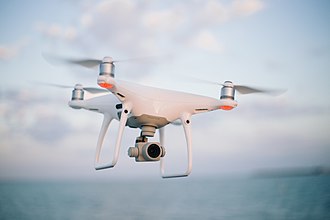
Four-rotor helicopters (quadcopters) were pioneered as early as 1907 in France. Along with other types of multicopters, they have mainly been developed for specialized uses, such as commercial unmanned aerial vehicles (drones). This growth followed the rapid expansion of drone racing and aerial photography markets in the early 21st century. Recently, these craft have also been weaponized for uses such as artillery spotting, aerial bombing, and kamikaze drones.
Etymology
The English word helicopter comes from the French word hélicoptère, which Gustave Ponton d'Amécourt created in 1861. It is made from two Ancient Greek words: helix, meaning "spiral" or "whirl," and pteron, meaning "wing."
English speakers often split up the word into heli- and -copter, which is not correct from a word-history point of view. This has led to words like helipad and quadcopter. Other English nicknames for the helicopter include "chopper," "copter," "heli," and "whirlybird." In the United States military, a common military slang term is "helo" (pronounced /ˈhiː.loʊ/).
Design
Further information: Tail rotor
Main articles: Aircraft engine and Turboshaft
A helicopter is a type of rotorcraft in which lift and thrust come from one or more horizontally-spinning rotors. Most helicopters have one main rotor, which creates aerodynamic drag and a turning force that must be countered. The design that Igor Sikorsky settled on for his VS-300 used a smaller tail rotor to push or pull against this turning force, and this has become the most common design. Other helicopters use a ducted fan or NOTAR instead. The number, size and type of engines decide what a helicopter can do. Early engines were too weak to lift people, but the internal combustion engine changed that at the end of the 19th century. Today, all but the lightest helicopters are powered by turbine engines. A transmission uses gears and clutches to pass power from the engine to the rotors.
A helicopter has four flight controls: the cyclic, the collective, the anti-torque pedals, and the throttle. The cyclic is usually between the pilot's legs and moves the helicopter forwards, backwards, and from side to side. The collective changes the lift of the main rotor blades. Some helicopters are built as a compound helicopter, with extra fixed wings and a separate thrust system that takes some of the work off the rotor during flight, which can increase the aircraft's top speed.
Flight
There are three basic flight conditions for a helicopter: hover, flight forward, and the change between the two. Hovering is the hardest part of flying a helicopter, because the pilot must keep making small corrections to hold the helicopter in place. The cyclic controls movement forward, back, left, and right, the collective keeps the helicopter at a steady height, and the pedals control the direction the nose points, or its heading. Each control affects the others, so a change in one means the pilot must adjust the other two.
A hovering helicopter sits inside a vortex of air that pushes it down, so the engine must make enough power to lift the helicopter's weight and push against that downward air. When the helicopter moves forward, it leaves this downward air and enters a state called translational lift, which gives extra lift without using more power. This usually happens at about 16–24 knots (30–44 km/h; 18–28 mph). In forward flight, the controls work more like those of an airplane, and the pedals are usually not needed. Helicopters also do not have yaw that causes a problem in forward flight. If the engine stops, the helicopter enters autorotation, where air moving up through the rotor keeps the main rotor turning.
Uses
Helicopters can take off and land straight up and down, hover for long periods, and handle well at low speeds. This lets them do jobs that other aircraft could not do, or that took a lot of time or work on the ground. Today, helicopters are used for transportation of people and cargo, military work, construction, firefighting, search and rescue, tourism, medical transport, law enforcement, agriculture, news and media, and aerial observation, among other things.
A helicopter that carries loads on long cables is called an aerial crane, and it is used in the logging industry to lift trees from places where roads cannot be built. Helicopters have also given aerial views for electronic news gathering. The largest single non-combat helicopter operation in history followed the 1986 Chernobyl nuclear disaster, with hundreds of pilots flying airdrop and observation missions. In firefighting, "Helitack" helicopters fight wildland fires using aerial firefighting and helibuckets, and they deliver firefighters who rappel down to hard-to-reach areas. Common firefighting models include the Bell 205 and the Erickson S-64 Aircrane. Air ambulances provide emergency medical assistance, often called "MEDEVAC." This use began in the Korean War, where the time to reach a medical facility fell from eight hours in World War II to three hours, and then to two hours in the Vietnam War. Police departments use helicopters to chase suspects and watch from above, often using heat-sensing equipment at night. Military forces use attack helicopters equipped with missile launchers and miniguns, and transport helicopters that can reach places without an airstrip, including for an air assault. Unmanned aerial systems are built for reconnaissance and surveillance, and navy helicopters use dipping sonar for anti-submarine warfare. Oil companies use helicopters to reach oil platforms quickly. NASA developed Ingenuity, a small helicopter that surveyed Mars. In 2017, Airbus Helicopters led helicopter sales, followed by Leonardo, Bell Helicopter, and Robinson Helicopter. Among helicopters in use, the most common models are the Robinson R44, the AS350, and the Bell 206, while Russian Helicopters, Sikorsky Aircraft, and MD Helicopters also operate many aircraft.
History
See also: Bamboo-copter, Science and inventions of Leonardo da Vinci, and Leonardo's aerial screw
Since around 400 BC, Chinese children have played with bamboo flying toys, which are spun like a top and fly when released. A 4th-century AD Chinese book by Ge Hong reportedly describes some ideas behind rotary wing aircraft. Later, Leonardo da Vinci designed a machine that could be described as an "aerial screw," and in 1754 Mikhail Lomonosov showed a small model that was powered by a spring. People kept working on the idea of vertical flight, and Sir George Cayley was influenced by the Chinese flying top as a child. The word "helicopter" was first used in 1861 by Gustave de Ponton d'Amécourt. In 1877, Enrico Forlanini built an unmanned steam-powered helicopter that rose 13 meters (43 feet) into the air in Milan. In 1901, Hermann Ganswindt made a flight in Berlin that was probably the first motor-driven flight carrying humans that was heavier than air. Ján Bahýľ flew a helicopter in 1905 that reached 4 meters (13 feet) and flew for over 1,500 meters (4,900 feet).
In 1907, the French brothers Louis Breguet and Jacques built the Gyroplane No.1, which lifted its pilot into the air but needed men at each corner to keep it steady. Later that year, Paul Cornu built a helicopter that made the first truly free flight with a pilot. Another Danish inventor, Jacob Ellehammer, built a helicopter in 1912 that made several free take-offs.
In the 1920s, Raúl Pateras-Pescara de Castelluccio showed one of the first successful uses of cyclic pitch, which helped control the lift of the rotors. In 1924, Étienne Oehmichen set the first helicopter world record recognized by the FAI. Oszkár Asbóth built a prototype in 1928 that took off and landed at least 182 times. Juan de la Cierva invented the autogyro in the early 1920s, which became the first practical rotorcraft, though it could not truly fly straight up and down. In 1936, the Focke-Wulf Fw 61 first flew, and it was called the world's first practical helicopter. During World War II, Nazi Germany used helicopters in small numbers. In the United States, Igor Sikorsky designed a simpler single-rotor helicopter, the VS-300, in 1939. His R-4 of 1942 was the first large-scale mass-produced helicopter. Bell Aircraft built the Bell 47, which became the first helicopter certified for civilian use in the United States in 1946. In 1951, Charles Kaman built the first turbine-powered helicopter, the K-225. Today, turboshaft engines are the preferred power for helicopters, because they allow larger, faster, and higher-performance aircraft.
Safety
Helicopters cannot fly as fast as fixed-wing aircraft. The blade moving forward through the air goes much faster than the helicopter itself and can reach the speed of sound, which causes much more drag and vibration. Blades are designed to flap so that the forward blade makes less lift and the backward blade makes more. Because of this, each helicopter has a safe top forward speed called VNE, meaning "velocity, never exceed." Engineers also work on helicopter noise reduction, since many city residents dislike noisy aircraft. Some heliports have closed, and governments have limited flight paths over national parks and other places of natural beauty. To reduce vibration, helicopters are adjusted for height and weight. A poorly adjusted helicopter can shake itself apart. Monitoring systems such as Health and Usage Monitoring Systems (HUMS) help track vibration. Tail rotors can also lose control in some crosswinds, and a ducted tail avoids this problem. Gearboxes have long been a weak point in helicopter reliability. Pascal Chretien designed, built, and flew the world's first man-carrying, free-flying electric helicopter, which was developed in Venelles, France.
Helicopter safety is also supported by voluntary teams, such as the U.S. Helicopter Safety Team (USHST), which publishes accident reviews and encourages better training and safety technology. Pilots must watch for several hazards, including:
- Settling with power, when the helicopter does not have enough power to stop its descent. If not corrected early, it can turn into a vortex ring state.
- Retreating blade stall, which happens at high speed and is the most common limit on forward speed.
- Ground resonance, a self-reinforcing vibration that can occur in an articulated rotor system when the blades become unevenly spaced.
- Low-G condition, a sudden change to negative G-force that causes loss of lift.
- Dynamic rollover, where the helicopter pivots around one skid and tips onto its side, similar to a ground loop in a fixed-wing aircraft.
- Powertrain failures, especially within the shaded area of the height–velocity diagram.
- Brownout in dusty conditions or whiteout in snowy conditions.
- Controlled flight into terrain, when the aircraft is flown into the ground unintentionally.
World records
| Record type | Record | Helicopter | Pilot(s) | Date | Location | Note |
|---|---|---|---|---|---|---|
| Speed | 400.87 km/h (249.09 mph) | Westland Lynx | John Trevor Egginton (UK) | 11 August 1986 | UK | |
| Distance without landing | 3,561.55 km (2,213.04 mi) | Hughes YOH-6A | Robert G. Ferry (USA) | 6 April 1966 | United States | |
| Around-the-world speed | 136.7 km/h (84.9 mph) | Agusta A109S Grand | Scott Kasprowicz (USA) | 18 August 2008 | From and to New York City via Europe, Russia, Alaska, Canada | No in-flight refueling |
| Highest altitude without payload | 12,442 m (40,820 ft) | Aerospatiale Lama | Jean Boulet (France) | 21 June 1972 | France | |
| Highest level flight altitude | 11,010 m (36,120 ft) | Sikorsky CH-54 Tarhe | James K. Church | 4 November 1971 | United States | |
| Altitude with 40-tonne payload | 2,255 m (7,398 ft) | Mil V-12 | Vasily Kolochenko, et al. | 6 August 1969 | USSR | |
| Highest takeoff (turbine) | 8,848 m (29,029 ft) | Eurocopter AS350 | Didier Delsalle | 14 May 2005 | Nepal | Mount Everest |
| Highest takeoff (piston) | 4,300.7 m (14,110 ft) | Robinson R44 | Mark Young | 12 October 2009 | United States | Pike's Peak, Colorado |
| First manned electric flight | Purely electric hover | Solution F Prototype | Pascal Chretien | 12 August 2011 | France | Venelles |
| Longest human-powered lift | Pedalling, lift 64 s endurance, 3.3 m height; diagonal width: 46.9 m | AeroVelo Atlas, 4 rotors | Todd Reichert | 13 June 2013 | Canada | Indoor soccer stadium; Igor I. Sikorsky Competition winner |

Quiz time!
5 questions about Helicopter
Why can helicopters be used in crowded or isolated places where airplanes often cannot land?
Pictures
Keep exploring



This article is a child-friendly adaptation of the Wikipedia article on Helicopter, available under CC BY-SA 4.0.
Images from Wikimedia Commons. Tap any image to view credits and license.